Do we seek wisdom? Will we take up the cross?
Feast of the Exaltation of the Holy Cross, Year C
(Audio recorded live, 14 September 2025)
Readings:
Num. 21:4b-9; Ps. 78; Phil. 2:6-11; Jn. 3:13-17
Today is the Feast of the Exaltation of the Holy Cross, one of the oldest celebrations in the Church, rooted in the early veneration of the true Cross of Jesus in Jerusalem. As I mentioned in my pastor’s letter in this week’s bulletin, the early Christians originally celebrated this feast by bringing crosses to the site of the Holy Sepulchre of Jesus. By the fourth century, St. Helena, a Christian convert and mother of Emperor Constantine the Great, discovered the relic of the True Cross of Christ in Jerusalem. A miraculous healing of a dying woman identified the True Cross as the one that brought her back to life. St. Helena, together with Bishop Macarius of Jerusalem, then ordered the demolition of the pagan temple of Venus that covered the holy site. Two basilicas were erected, the Anastasis (Church of the Holy Sepulchre) and the Martyrion on Golgotha, where Christ was crucified. The relic of the True Cross was lost for a time to the Persians, but was returned to Jerusalem under Emperor Heraclius in the early seventh century. This event gave the September 14th feast its special significance. The relic of the True Cross of Christ remains in the Church of the Holy Sepulchre where it is encased in silver and venerated by pilgrims from all over the world.
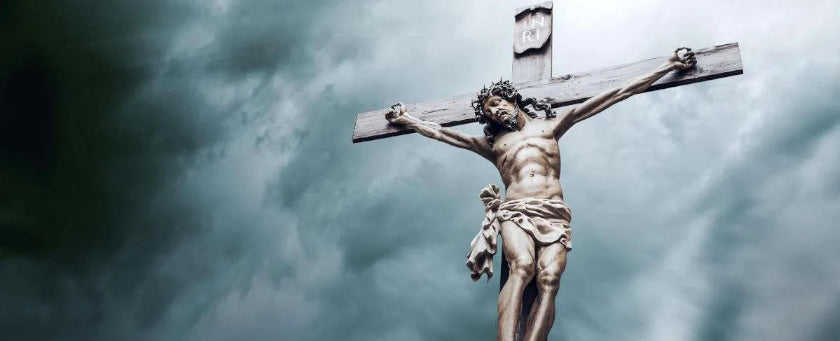
The veneration of the Cross is paradoxical. A paradox is statement that seems to contradict itself but is nonetheless true. The cross is an instrument of terrible suffering and death, but as Christians we also see the Cross as the instrument of our salvation. How can something that represents ultimate suffering also represent salvation? Because the One who suffered and died rose again on the third day. Jesus appeased the wrath of the Father brought about by sin, and offered the best that humanity had to offer, namely, himself, as the perfect man. As it says in the letter to the Hebrews:
“Now since the children share in blood and flesh, he likewise shared in them, that through death he might destroy the one who has the power of death, that is, the devil, and free those who through fear of death had been subject to slavery all their life. Surely he did not help angels but rather the descendants of Abraham; therefore, he had to become like his brothers in every way, that he might be a merciful and faithful high priest before God to expiate the sins of the people” (Heb. 2:14-17).
The role of the Temple high priest was to offer sacrifice for sins; the role of Jesus, the true High Priest, is to be the sacrifice for sins. In other words, Jesus offers himself: Fully human, fully Divine, in total submission to the Father. This is why Jesus says to all, “If anyone wishes to come after me, he must deny himself and take up his cross daily and follow me” (Lk. 9:23). He also says, “Everything that the Father gives me will come to me, and I will not reject anyone who comes to me, because I came down from heaven not to do my own will but the will of the one who sent me” (Jn. 6:37-38). The prophet Isaiah speaks of this will when he says, “Yet just as from the heavens the rain and snow come down and do not return there till they have watered the earth, making it fertile and fruitful…So shall my word be that goes forth from my mouth; It shall not return to me empty, but shall do what pleases me, achieving the end for which I sent it” (Is. 55:10-11). Part of that end for Christ was the Holy Cross, but it was not a conclusion, rather, a culmination of everything the Father sought to accomplish through the Son: the restoration of humanity to right relationship with the Father. And now that Jesus has been raised from the dead, we have a glorious High Priest who sits at the right hand of the Father interceding for us.
Just as the bronze serpent was lifted up such that all who looked upon it may be healed, so too, is the Son of Man lifted up so that everyone who believes in him may have eternal life (cf. Jn. 3:13). Jesus explains why God did this. He says, “For God so loved the world that he gave his only Son, so that everyone who believes in him might not perish but might have eternal life” (Jn. 3:16). This is one of the most often quoted phrases from the Gospel of John, but another is like it: “No one has greater love than this, to lay down one’s life for one’s friends. You are my friends if you do what I command you” (Jn. 15:13-14).
And so, today, as we venerate the Holy Cross of Christ, let us be mindful of all that has been accomplished through it, that the Cross represents not death, but new life in Christ, and most importantly of all, that the Holy Sacrifice of the Mass places each of us at the foot of the Cross at the very moment Jesus died for our sins. May the communion we share unite us as brothers and sisters in Christ, and help us to pick up our own crosses and follow him, to the glory of God the Father.

Share this post
Twitter
Facebook
Pinterest
Email