We are Children of the Light Not the World
Twenty-Fifth Sunday in Ordinary Time, Year C
(Audio recorded live, 14 September 2025)
Readings:
Am. 8:4-7; Ps. 113; 1 Tm. 2:1-8; Lk. 16:1-13
Jesus says, “For the children of this world are more prudent in dealing with their own generation than are the children of light.” This statement is as important now as it was when Jesus first said it. In context, Jesus is talking about man’s desire to build his own empire on earth. The children of this world describe the godless—those who try to squeeze everything out of this short life on earth that they can. We heard of these people in the first reading. They say, “When will the new moon be over…that we may sell our grain, and the sabbath, that we may display the wheat?” They are not interested in worshiping God, but increasing their bottom line. They even go so far as to turn the lowly and the poor into slaves. These were dishonest stewards to put it mildly. Their hearts were far from God because they were only concerned with the things of the world. As Jesus says, “For where your treasure is, there also will your heart be” (Mt. 6:21).
We might ask ourselves where is our treasure? When we survey the landscape of our country and the world, where is the treasure of our people? What is the treasure of America? For centuries, the term America has been synonymous with freedom and prosperity rooted in the declaration that all men are created equal, endowed by our Creator with unalienable rights such as life, liberty, and the pursuit of happiness. How are we as Americans embodying this reality?
The recent shootings have something in common. The perpetrators were both young men in their early 20s. What does this say about the young people of today? We have failed to teach them the values of God. As Americans, they had the same unalienable rights as anyone else, but they chose to infringe upon the rights of others. Maybe they were radicalized. Either way, they did not have the solid foundation of values to fend off the attacks of the Evil One. Instead, they gave in to evil and took what did not belong to them—they took someone’s life. This theft is at the heart of today’s gospel.
I contend that people who resort to extreme violence have not allowed Christ to enter their hearts. But, how can the people allow Christ into there hearts if there is no one to preach? St. Paul tells us faith comes through hearing. But, the Devil seeks to isolate us from one another to tear us apart from the inside out. There is tremendously evil rhetoric against the Catholic Church, especially online. Nevertheless, Christ unites us as His chosen people. He says, “For where two or three are gathered together in my name, there am I in the midst of them” (Mt. 18:20). In the Book of Genesis, God says, “It is not good for the man to be alone” (Gn. 2:18). We are communal beings and need to be in relationship with one another. Not online, but here. And when circumstances drive individuals to greater isolation, they grow to despise true community. Such hate festers and manifests in dreadful ways as we have seen.
But, this Sunday is Catechetical Sunday, a day when we acknowledge our many catechists and teachers of the faith. How can we respond to the evil of the world? By teaching the Good News of Jesus Christ. This year, I am proud to see the enrollment of nearly 200 students in our Children’s Religious Formation program. And the number of our volunteer catechists has also increased this year, which is a great sign of their growing desire to hand on the faith.
Handing on the faith is part of what it means to be a child of the light. The analogy of light and dark is ancient. The light refers to knowledge or wisdom, while the dark refers to ignorance or lack of understanding. The children of the world have wisdom of worldly things. The dishonest steward in today’s gospel has this worldly wisdom. He was likely inflating prices so he could amass more wealth for himself. Once he was caught, the master told him to make an account of his stewardship. Realizing he is too weak to dig and too ashamed to beg, he goes to the master’s contractors and offers them a discounted rate, which at one and the same time wins their esteem and earns him a commission. The master commends the steward for acting prudently.
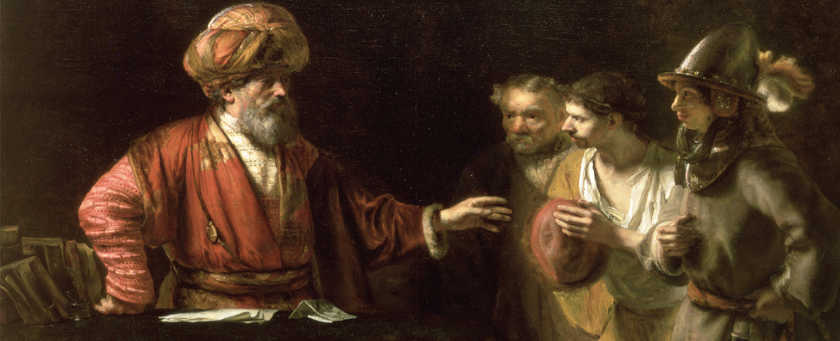
Jesus says, “Make unto you friends of the mammon of iniquity: that when you shall fail, they may receive you into everlasting dwellings” (Lk. 16:9). In other words, we are to use the money of the world for righteous ends, to promote the kingdom of God while we are on earth. The dishonest steward used money to build up his own house; we are to use money to build the house of God.
Jesus says, “You cannot serve both God and mammon,” yet we realize that both are needed to carry out the mission. In this Jubilee Year of Hope, we are reminded of the promise of Christ, that he is with us always, especially in the Eucharist. As we turn now to the celebration of our communion with God and one another, let us pray for an end to violence in the world and an increase in the peace of Christ, that all who find themselves isolated from others may encounter Jesus, be transformed, and come to the knowledge of the Truth, the Truth that makes us all free.

Share this post
Twitter
Facebook
Pinterest
Email